Showing posts with label Organization. Show all posts

9/27/18

2 Low Vanilla Bean Prices for Extract

Updated 10-2021

Making your own vanilla extract is very simple, easy, and makes a noticeable difference in your recipes. All you need are vanilla beans, vodka, bottles, and if you want to gift your vanilla extract, you may want a pretty, decorative label to make it extra special. You can view this post to see all the pretty ways folks have bottled and packaged their homemade vanilla extract.

You can use the traditional cold extraction method of putting your vanilla beans in your bottle of vodka, and shaking it weekly for 4 months, or use a much quicker method of heat extraction, using an electric pressure cooker, enabling your extract to be ready in as little as 2 weeks. I have another sous vide vanilla extract recipe that uses a pressure cooker without using any pressure


Vanilla Extract Math
Update 9-2020: Good news! Prices of vanilla extract and vanilla beans are going down. It is currently about $28, but you can still make it yourself for less.

A trip to Costco, which has low prices for many things, had me glancing over at their vanilla extract in the baking aisle. $34.99 for 16 oz. Yikes!


It can be overwhelming, to say the least, to shop for vanilla beans!  The cost of pure vanilla extract has nearly tripled over the last couple of years, due to storms and demand vs supply. You want to make sure you have the highest quality vanilla beans and at the best price.

Let's use the Costco price as our cost basis for making vanilla extract. In my experience, it is more economical to purchase vanilla beans in larger quantities and use a large bottle of vodka or clear rum. For a more, in depth cost analysis, you can check my vanilla extract post from 2017 here.

The lowest price for Madagascar vanilla beans, according to the spreadsheet below, is from Ebay and includes free shipping from France. These are 5" in length, grade B, and the seller has positive feedback. Since it may take up to 2.5 weeks for the beans to arrive, I may choose another seller. You will also need to consider the cost of your bottles, should you choose to put your extract in smaller bottles, but for now, you can put your extract back into your vodka bottle, since it is sterilized and ready to use.

Costco Vanilla extract: $34.99 ($2.19 per ounce)

Kamchata vodka 1.75 liter (7.3 cups, or 59 oz) $11.49
10 Bouron vanila beans                                     $24.50
Total Cost:   $35.99
Yield: 7 cups or 55 oz
Cost per ounce: .65 cents  per ounce

Let's try another vanilla bean company, Beanilla, a reputable company that sells a variety of vanilla beans. At the moment, they have a 5% off discount email code and free shipping in the USA. Let's look at their grade B Madagascar beans for $37.95.

Kamchata vodka 1.75 liter  $11.49
10 Madagascar beans         $37.95
Total Cost:      $49.44
Yield: 55 oz
Cost per ounce: .90 cents

In order to more closely match the price of Costco's vanilla, you would need to pay $11 per bean, using the cost of vodka at $11.49.

Example:
Kamchata vodka, 1.75 liter $11.49
10 vanilla beans                 $110.00
Total Cost:  $111.49
Yield 55 oz
Cost per ounce: $2.21

Choosing your Vanilla Beans

Now that we have established that it is more economical to make your own vanilla extract, let's talk about how to choose a vanilla bean and which company/seller to purchase from.

Grade
There are 2 grades of vanilla beans.
Grade A vanilla beans are culinary grade, are moist, dark, plump and are often split, scraped, and the 'caviar' (seeds and pulp) are used in recipes from baking to cooking. They are fine to use in making vanilla extract.

Grade B vanilla beans are often called "extract grade," and are not used in culinary recipes, but for making vanilla extract. They are drier, and sometimes cannot be split down the length of the bean to scrape out the caviar. Instead, you will want to cut these dry beans into 1"-2" pieces for your extract.

Flavor
There are several types of vanilla beans, each producing their own aroma and flavor. Madagascar, also known as Bourbon vanilla beans are the most common and what you may be more familiar with.  The flavors can vary from rich, creamy, floral, to bold and cherry-chocolate flavor.

  • Madagascar (Bourbon) - rich, creamy, traditional 
  • Mexican - bold, smokey, dark, hint of spice
  • Indonesian - mild, well balanced
  • Tahitian - floral, cherry-chocolate
  • Tongan - earthy, fig raisin

Quality
Grade A vanilla beans are typically 6"-8" in length. They should be dark, plump, and pliable.
Grade B vanilla beans are drier, can be split or cracked. They are often shorter, but look for the longest beans you can find.

Where to Purchase
You can find vanilla beans in your grocery market, often in the spice or baking aisle. You may only find them in packages of 2 or 3 beans and they can cost much more than purchasing vanilla beans in  groups of 10 online. Some local bakeries may have vanilla beans for sale.

When purchasing vanilla beans online, you will want to first look at the reviews. Look for reviews that say their vanilla beans arrived on time, and in good condition. Check for any shipping charges and factor that into your overall cost. Some companies offer a discount for first time buyers.

How many?
1-2 vanilla beans per cup of vodka is the ratio that I use for the pressure cook method. If you are planning to use the cold extraction method, you may need to use as many as 6 beans per cup. It really depends on the length, quality of the vanilla bean, and how strong you want your vanilla to be. Some bakers double the strength of their vanilla extract by doubling the number of the beans per cup of liquor. If you make a double strength, you will increase the cost of your vanilla extract, but you can also use half as much in your recipes.

I hope you find this information informative and helpful as you decide to make your vanilla extract.

If you have any favorite sources that you want me to add to this list, let me know and I'll be happy to include the information. I'll keep this list updated as I see the prices change.

Enjoy!


3/8/17

0 Cool Kitchen Tool: OXO Dish Brush


I love OXO products ~ they are well designed and last a long time. I have had this OXO Good Grips Dish Brush set for a little over 5 years and I use it every - single - day. I have pushed that little black button so many times that it developed a little crack and needed a replacement.


Using the OXO dish brush is very simple. Open the end cap and fill it with your favorite dish detergent.


Put the cap back on, lightly push the rubber button, and a pre-measured squirt of dish soap comes out.


The nylon bristles do a great job of scrubbing and is safe to use on non stick cookware.


There's even a little scraper at the tip of the brush for baked on foods.


The brush holder has a non-skid base, catches any drips, keeping the brush dry - There is a little open slit near the bottom of the holder - Tip the holder and the excess soapy water runs out into the sink. It is important to do this every so often... if you forget, the soapy water will start to smell. Ask me how I know...


There are so many things that need hand washing - this Kitchen Aid Flex Edge beater needs to be hand washed. Cookie sheets, Silpat Baking mats, and other large items that don't fit well in my dishwasher are easy to clean with the OXO dish brush. I use it for any kitchen utensil that has a wooden handle, such as steak knives.

Every few days, I will take the brush off and let the dishwasher give it a good cleaning. The replacement brushes come in a two-pack and are handy to have while one is being washed.


If you are single, or living with roommates at school, washing a dish or two is so much easier than letting them pile in the sink or wait for a full load in the dishwasher. I love having this dish brush handy to wash my Kitchen Aid bowl in between mixing sugar cookies and making frosting.

Does this OXO Dish Brush meet my Cool Tool Requirements?
Comfortable to use? Yes - fits well in my hand and is easy to use.
Easy to store? Yes - it has a permanent home on the counter near my sink.
Easy to clean? Yes - throw the brush into the dishwasher at least once per week.
Serve more than one purpose? No - but it does its only job very well!
Good quality for the price; durable? Yes! I got this for about $10 and it lasted me 5 years of daily use!
Use often? Yep! Every single day!

I know you will love having this OXO Dish Brush as a daily cleaning companion. OXO products are well designed and will serve you well.

I was not compensated to write this post - I simply love OXO products and use them in my kitchen. All opinions expressed in this post are mine, but you can find out how great this Cool Kitchen Tool is for yourself.  :-)

4/28/15

14 Instant Pot Dulce de Leche -Pressure Cooker Caramel


Dulce de Leche.

Can you pronounce it?  I can't.

All I can tell you is this.

It is sweet, brown, deliciousness. Many folks call it a caramel.

Literally translated, it means "candy milk."

I'll take that!

It is traditionally prepared by slowly heating sweetened milk, changing its flavor and color, resulting in a thick, sweet caramelly sauce. It can be made in the oven, stove or microwave. 

What do you use this stuff for?  Well, just about anything. Over ice cream, on a cake, in a crepe, sandwiched between cookies, dip pretzel sticks, apple slices or just dipping a plain 'ole spoon will do.

I have heard that this glorious stuff can be made in a pressure cooker.

Wait a minute.  Put a sealed can in a pressure cooker?  Won't it explode?

Is is Safe to use the unopened can in the pressure cooker?

Sweetened condensed milk labels now have the warning: "Do not heat in the can."
I searched high and low to find the reason, and this is the only conclusion I can come up with:  Sweetened condensed milk has been heated in a can for years. However, some anxious folks out there have tried to move or open a HOT can, and guess what? Hot caramel lava went everywhere.

The takeaway for me is to leave the cans alone and don't move or open them until they are completely cooled. 

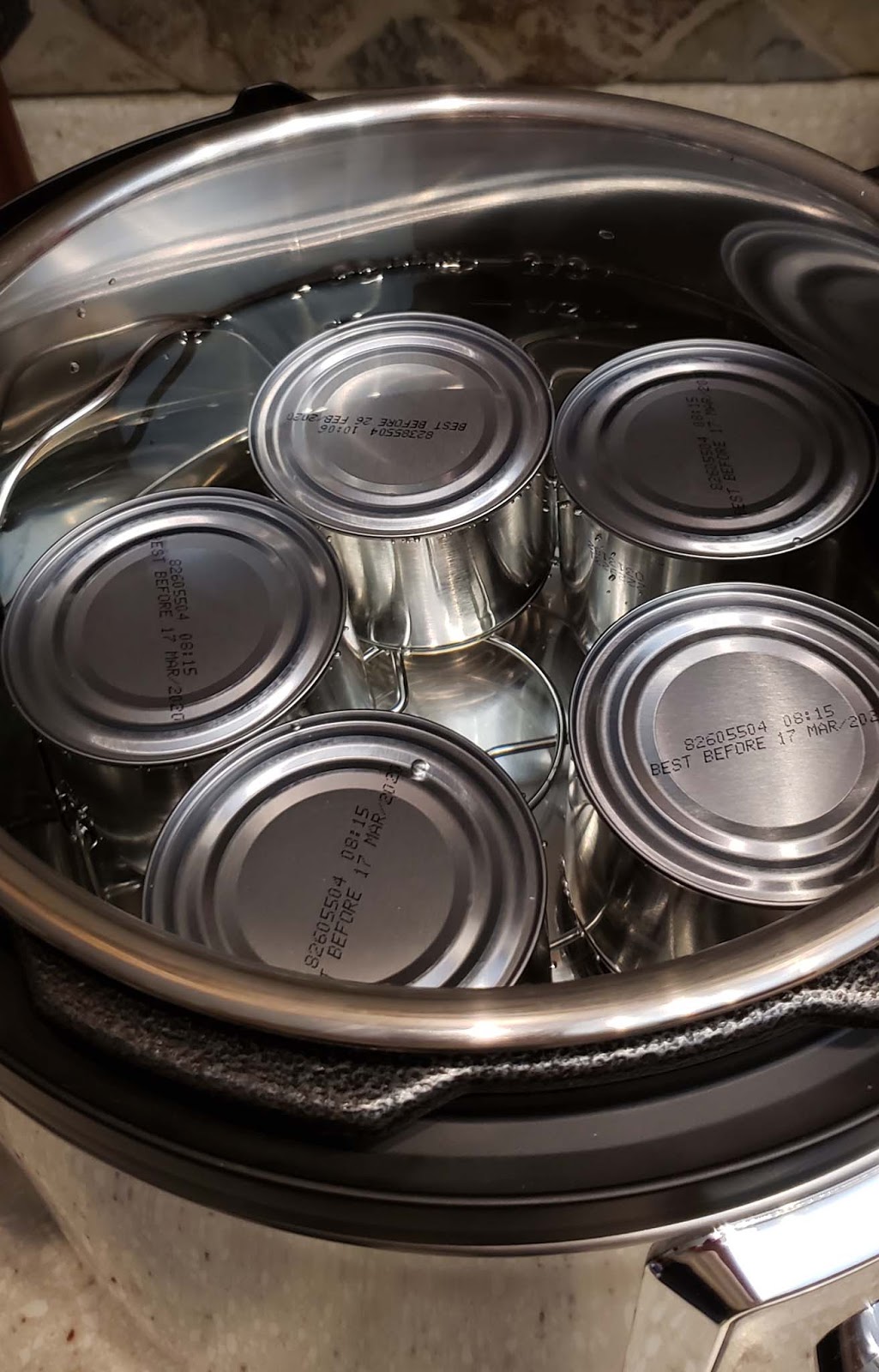
Here's a video, with 5 cans of sweetened condensed milk, cooked for 15 minutes and a full natural release. All the cans are intact! Now, it's time to let them cool.


But wait.... is it safe to EAT the dulce de leche cooked in the can?

Some people have mentioned that BPA (bisphenol A) that is used to line the cans can leach into the caramel under high heat. Did you know that as of 2018, at least 90% of cans no longer contain BPA


1.  Remove the paper from the can. Remove ALL the glue from the can. Use a cotton ball soaked with rubbing alcohol to remove the glue.

Inspect the can for nicks, dents, or bulges. 


If there is any glue left on the can from the label, it will melt, stick onto the liner of your pot, and be really, really hard to remove.

2.  Put the trivet in your pressure cooker.


3. Place can (or cans) on its side and fill pot with water. 


 Make sure you do NOT exceed the MAX fill line. 


4. Close and lock your pressure cooker. Select HIGH for 15-20 min. (The longer you cook the milk, the darker it will be). My cooker came to pressure at 33 minutes, then cooked for 15 minutes.


5. Turn pressure cooker OFF, allow to naturally release the steam on its own.

6. When the pressure valve drops, you can open the lid, but DO NOT REMOVE THE CAN.

7. Let pressure cooker sit, undisturbed, for a couple of hours or over night.  You want the cans to be cool enough to handle, so let it sit.   For curious kids and hubby, I made a sign:


8. Next day, remove the can, dry it off and write on the can, "Dulce de Leche." Store unopened can on the shelf. 


Open, indulge, and if there is any left over, transfer to an air tight container and put in the fridge for up to 3 weeks.


If opened and you need it to last longer, put in a freezer safe container and freeze for up to 3 months.

If the dulce de leche is too stiff, you can warm it in a pan/double boiler with a little bit of milk...


Mmmmmmm..... don't think this can will last long.... 


Thanks to all those who went before me and made this possible:


print recipe

Dulce de Leche - Pressure Cook
Caramelized sweet milk is now even easier, using your pressure cooker. What used to take 3-4 hours on the stove and even longer in your slow cooker, now takes 20 minutes under pressure. If you want a lighter color, cook it for less time. This sweet spread can be enjoyed over ice cream, cake, in a crepe, sandwiched between cookies....
Ingredients
  • 1 (14oz) can sweetened condensed milk
  • Water
  • Trivet or steamer basket
Instructions
1. Remove the label from the can.2. Remove ALL the glue from the can; otherwise the residual glue can make a mess in your pot that is difficult to remove. If you can't remove all the glue, wrap the outside of the can in aluminum foil.3. Put the trivet or steamer basket in the pressure cooker.4. Place the can(s) on the trivet/steamer basket.5. Fill the pressure cooker with water, to the MAX line or at least 1" above the can. It is important that the water completely covers the can.6. Close the lid, close the pressure valve, and set if for HIGH pressure.7. Set the time for 15-20 minutes. The longer cook time produces a darker color. 8. At the end of the cook time, turn the pressure cooker OFF and allow a full natural release. 9. When the float valve drops, you can remove the lid, but DO NOT REMOVE THE HOT CAN. 10. Allow the the water to cool completely for a few hours (I let it cool over night). Remove cooled can from pressure cooker, label and store on the shelf.Open, use, or transfer to an airtight container and keep in the fridge for 3 weeks or freezer for up to 3 months.If the dulce de leche is too stiff, warm it over a double boiler on the stove with a little milk to desired consistency.
Details
Prep time: Cook time: Total time: Yield: 14 ounces

3/31/15

0 4 Kitchen Design Flaws: Should It Stay or Should It Go?


I have been with my kitchen for almost 17 years. It has been by far the largest and most used kitchen I have ever lived in. It is one of those "cookie cutter" kitchens that were so much like others in my neighborhood and made the selection process very easy.  "Which of the three cabinets do you want? Oak, Maple or Alder?" We chose alder for it's warm color.  Cabinet knobs were either solid brass or nickel. Counter tops were solid surface and choices were limited.  The only wide range of choices we had were in the lighting.

So excited to move in, the first thing I did was open the refrigerator. Boom. The lights went out. Opening the fridge door blew a fuse. Grrrrrr.... called the contractor and he immediately fixed it the next day.


I opened my beautiful Kitchen Aid side by side fridge and immediately noticed DESIGN FLAW #1:


Boom.  The fridge left door stopped and banged against the counter. For the next 12 years, I would not be able to access the the fridge drawers fully because of this major design flaw.  That was why I was so thrilled when it finally died and I got another beautiful fridge, which only partially solved the problem.

In spite of our limited choices in building this home, I was adamant that we would have a double oven. The kitchen was designed to have a built in range/stove, but I insisted on the double oven.


The oven went in to what was to be a very large walk in pantry. Enter DESIGN FLAW#2:

They didn't build any storage above OR below the double oven.  Sheeze. So, here is where my baking pans, parchment, rolling pin, etc. go... in the bottom of the double oven. I hate having to unload everything each time I use this oven, which is great for large group gatherings.


In my walk in (more like "step in") pantry,  I was left with was this black hole where odds and ends would disappear....DESIGN FLAW#3.  In the evening, the pantry is very dark and it is difficult to see things, especially on the upper two shelves and the bottom shelves.


The last thing that frustrates me about this kitchen is the lack of natural daylight. In this photo, I have all the blinds pulled up and the lights on. The kitchen is on the north side of the house and the red wall blocks the sunlight from the large south window. Design Flaw #4


Over the years, this kitchen has served me well, but I think it's time for a change, don't you?


2/19/15

0 Four Steps to Making A Family Story Cookbook

Great Grandma's Butter Dream Cookies 
Midwestliving.com


After attending RootsTech, a genealogy conference here in Salt Lake City, I was definitely overwhelmed and inspired.

Overwhelmed? Yes.  There is so much work to be done, finding our anscestors and sharing their stories.  My husband loves the "hunt" and "discovery" of genealogy, so this part belongs to him!

Inspired?  Yes.  To continue documenting my life and the lives of our family members through stories, pictures, and food.

Food?  Yes, food is a part of YOUR history!

These days, families may get a store-bought pre-packaged family meal.  Wouldn't it be great to capture and preserve YOUR family's favorite home-cooked Thanksgiving favorites?  If your family doesn't have a tradition, it's never too late to start one.

Do you have a family favorite recipe?  Is there a story that goes with the recipe?  How about a photo of the story or recipe?  If so, you've got the perfect recipe to making a Family Story Cookbook.

Funeral Potaotes

There are many ways of going about starting a Family Story Cookbook.

First, capture story ideas.  Think about the foods you and your family have loved.  Hated. Foods that have reminded you of a holiday, event, or vacation. Use a timeline to jot down your notes.

Grandma's Chocolate Chip Cookies

Second, gather the recipes and photos.  Recipes that are handwritten and have stains are the most used and loved recipes.  Is there a story with the recipe?  Are old recipes safe? Recipes that use raw eggs (chiffon pies or soft souffles) can be replaced with meringue powder.  Canning methods also have changed.  Salsas are now canned using a pressure canner.  Pickles and jellies are canned using a water bath instead of paraffin.  Not everyone will like the recipe, but hey, if it has a story and a photo, record it anyway. Look through your family photos.  Does the photo remind you of a story?  Write your thoughts on your timeline.

From Cappersfarmer.com

Have a story and a recipe, but no photo?  Recreate the recipe and take a photo of it. The photo will be the first thing your reader will see and will be pulled into reading the story that goes along with it.

Photo Album for Recipe Cards

Third, where do you want your recipes to come from?  A single person, such as Grandma Tilly?  An event, such as birthdays?  Or a location, say, Italy?  You can ask your family members for their favorite recipe and have a family collection: The Smith Family Cookbook.  How about cooking from the decades or stories/recipes from a specific time period?  College Days: More Than Ramen?

When you  get your recipes, proof read each one and check for potential problems, like underdone eggs. Check for clarity of ingredients (what size can of tomato sauce) and directions.

Recipe 3 Ring Binder is what I use

You can now see there are many ways to start a family cookbook. Pick one and start gathering your recipes and stories.  Photograph kitchen gear and memorabilia. Family members may love to see what grandma's old flour sifter looked like.

Fourth, you've got your recipes, stories, and photos.  What are your publishing options?  You can go low tech:

Customizable 3 Ring Binders  with Clear Sheet Protectors
Photo Albums
Scrapbook Page
Make Decorative Recipe Cards

Or high tech:

Use Scrapbook Software
DIY Photo Books - Blurb.com
Scan original handwritten recipes

It's never too late to start. Start today and preserve those family favorite recipes!  What are your favorite recipes?


This post may contain affiliate links. For more information please refer to our Disclosure Policy.


12/16/13

0 Carton Smart!

This post brought to you by Carton Smart. All opinions are 100% mine.
I love square containers. They stack well and nest easily and don't suck up wasted space like round containers.  Square cartons are easy to ship, stack, and store! Ever tried to get cranberry jelly out of a can? This box makes it much easier!
 photo 62adf36b-e1dc-4d93-98c1-aa80d97a468d_zps600d562e.jpg
These new Smart cartons are much lighter than the heavy metal cans and have no need for can openers.  They are made of 70% recyclable paper, from selectively harvested, re-grown trees. Very smart.  Easy to open. Easy to pour. Reclosable. (Is that a new word?) I use what I need and save the rest for later.
 I love the space saving design that makes storing in my pantry and fridge more user friendly.
 photo d1d52bb8-c150-4f19-9a7c-b8c9ab3c8df3_zpsac6b75dd.jpg
The ingredients?  No weird, unpronouncable stuff here ~ Chicken stock is simply "water, chicken, carrots, celery and onions."  Jellied Cranberry sauce is simply "organic cranberries, organic cane sugar, & water."  The pumpkin puree?  "100% Organic Pumpkin."  100% organic, non-gmo and no preservatives!  Simple.  The way nature intended.
With the holidays, using these smart cartons make everyday baking so much easier! Here's to eating a luscious pumpkin pie...
I use chicken broth for many things.  I love that this chicken stock is unsalted (not salt free) and allows me to season my dishes just the way I want. I use chicken broth for gravy, sauces, red enchilada sauce, soups and to flavor my rice.  The uses are endless.
 photo 795e421d-1ec8-414e-b1b8-dde8f5f23ded_zps62983f0a.jpg
And it starts with a smart carton.
Be #cartonsmart this holiday season with recipes that use ingredients that taste great with little waste!

Become Carton Smart
Tweet @CartonSmart
Follow #CartonSmart on Pinterest
 photo 1898ca76-3272-4baf-a8df-07abf60e15e3_zps1bf425e9.jpg
Visit Sponsor's Site

1/13/12

8 Defrosting A Freezer & Keeping it Frost Free Longer


It's that time of year again.  You know how you feel the "need" to clean in the Fall and in the Spring?  Well I have that at the end of the year.  Time to put away the Christmas decorations, go through all my files, and yes, clean the freezer.

When I told hubby that I was not looking forward to this task, he asked, "Why not get a frost-free freezer?" 

This is why:  your frozen foods will stay fresher and you can freeze them for longer.  A frost-free freezer wicks a lot of the moisture from your frozen foods and shortens its shelf life.  Use a FoodSaver, and your frozen items will last up to two years in a standard freezer.

What I thought would take all day, really only took 2.5 hours.

Here is my before shot.  At the top left hand of the freezer is a HUGE frost chunk.  Wanna know why it's there?  I have a seal leak ~ frost builds up anywhere where air can reach your freezer.


How to check for seal leaks
You can check to see if you have any leaks by feeling for air along the seal, or give it the dollar bill test:  Stick a dollar bill between the door and the seal.  Close the door.  Tug on the bill; if it comes out easily, you've got a leak.


My freezer seal appeared to be in good shape; no cracks or breaks.  As to why I was getting an air leak in the top left hand side, it was probably because my freezer door was not "square."  It is also possible that this is where people "open" the freezer door, as my freezer does not have a handle.

I could have unscrewed the hinges and squared the door, but I opted to use a quicker, faster, easier method:  Fun-Tak.  This is the stuff my teen uses to hang posters and other objects on his bedroom wall.  After cleaning my freezer, this is what I did to help the door seal.  It worked!


To defrost your freezer, you will need some equipment:

1. Gloves.  Ski gloves work great!


2. Towels for the floor.


3. Coolers or bath towel lined cardboard boxes for your frozen goods.


4. Bowls filled with boiling water (use your gloves!)  
You can also fill large stock pots with boiling water.  
Close the freezer door and let the steam melt the frost.  
Change the water when it becomes room temperature.


5.Unplug the drain and put the drain hose in a pan or bucket.

6. Plastic or wooden spatula to scrape off frost.  
Do not use metal as you can take off the protective finish from some surfaces of your freezer.
7. After you are finished, plug the drain and return the hose to its original position. 

Secrets to Keeping your Freezer Frost Free Longer
Any air that is in your freezer will capture moisture and turn it into frost.
1.Use square packaging.  Boxes, milk boxes & plastic containers are great and acts as "drawers" in your freezer.


I found these baskets at the Dollar Store. They work great! 

2. Plug all empty spaces with plastic shopping bags. 
See all those *dead* spaces of air that can create frost?  Plug them with plastic shopping bags.


PRO TIP: The more you can keep your freezer FULL, the more slowly frost will develop.

I love my freezer!  I was able to take a mental inventory of everything, and throw out anything that had major frost bite.  I organized it with meats on the top shelf, veggies and grains on the next shelf, fruits and cheeses on the bottom shelf.


Related Posts Plugin for WordPress, Blogger...
Pin It button on image hover